Tarot Cards & Psychic Readings
The Visual Language Of Tarot Cards - Timeless Meaning
Learn how tarot cards serve as more than just a fortune-telling tool and their deeper meanings. How to facilitate true communication and self-discovery.
LOVE & RELATIONSHIP TAROT
Maya Britan
2/21/20253 min read
Need personal clarity?
• Love Tarot Reading
• One Question Tarot Reading
• Online Tarot Reading
If you feel called to explore your situation more deeply, you can connect with me through a personal reading.
I Am One Tarot – Intuitive Tarot Readings & Guidance

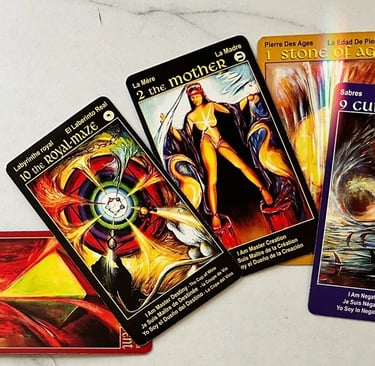
Tarot cards have a rich history dating back to the 15th century in Europe.
An even earlier appearance is also possible.
There is no concrete evidence to support the idea that tarot might have originated in Egypt.
Yet, this is not too far-fetched an assumption based on mass migration from Egypt to Europe in the late 18th dynasty, where most of Akhenaten's followers, who worshiped ATON (one God), were killed and destroyed.
The remains of these Egyptian people migrated to Europe but did not integrate well in the new environment; thus, as nomads, they were known to this day as "Gypsy" which is just another way to say "from Egypt" (pronunciation ee·jip·shn).
Why Is This Important?
People find meanings in tarot and are drawn to it by readers from different eras, backgrounds, cultures, and centuries. Do they all interpret the cards the same?
The answer is no.
What people considered important 200 years ago may be of little importance in modern society.
The I Am One tarot cards have a distinct connection to the 22 Hebrew alphabetical letters, which align perfectly with the 22 major arcana cards.
How is it possible that the tarot originated in Latin Europe?
The word 'tarot' has intriguing linguistic roots, particularly in the Semitic language of Hebrew and earlier Aramaic. In Hebrew, the term 'torot' signifies studies or commandments, offering a profound connection to the notion of guidance and wisdom intrinsic to the tarot's purpose.
Traditionally, the tarot is seen not merely as a tool for divination, but as a symbolic representation of universal truths related to human life experience.
The word "Bible" is "Tora" in Hebrew.
This connection between the concepts of studies and commandments resonates deeply within the context of the 22 major arcana cards that populate a standard tarot deck.
What did not change much over time is the imagery itself, as it was overhauled by the European style of art and the perception of hierarchy.
So, although the transition of tarot from a mere game to a spiritual tool may have occurred in the late 18th century, the esoteric learning format was already in the original tarot images.
It was then that scholars and occultists, most notably Antoine Court de Gébelin, began to ascribe esoteric meanings to the card imagery. This marked the birth of the tarot as a significant symbol of divination and a method of self-reflection and clarity.
Reading tarot cards resembles learning a new language, but instead of words, it unfolds through vivid imagery and symbolism. Each card acts as a visual cue, eliciting thoughts and feelings that words alone may struggle to convey.
This unique form of expression connects with our subconscious, allowing deeper insights to emerge.
As we interpret the intricate illustrations, our minds engage in a dance of intuition and creativity, facilitating an exploration of our inner landscapes.
The experience of working with tarot transcends mere divination; it becomes a journey into our imagination, where the unknown meets our narratives, providing clarity and understanding in ways that are often profound and transformative.
Through this visual language, we unlock pathways to self-discovery and reflection, inviting us to delve into the mysteries of our lives.
Reading tarot cards is akin to embarking on a journey through a new language, where the vocabulary comprises rich imagery and profound symbolism.
Each card serves as a visual prompt, sparking thoughts and emotions that transcend the limitations of spoken words. This remarkable form of communication connects us to our subconscious, enabling an emergence of deeper insights as the truth and wisdom from the ancient core of the tarot surface again to meet us where we are.
As we delve into the intricate illustrations, our intuition and creativity intertwine, leading us on a voyage of self-discovery. Working with tarot transforms the act of divination into an exploration of our imaginations, blending the unknown with our personal stories.
Ultimately, this experience offers clarity and a deeper understanding of ourselves, revealing truths that may otherwise remain hidden within the depths of our minds.
I Am ONE Tarot
© 2026 I Am One Tarot – Los Angeles, CA.
All rights reserved to Maya Britan
Privacy Policy & Terms
Los Angeles Psychic Tarot Readings
email: maya@iamonetarot.com